







Invoices are in your email, receipts have been sent to your accountant on WhatsApp, and contracts are stored on your computer. Everything seems organised until you need to find a particular document. Your accountant is on holiday, old messages are no longer available, and the paper receipt has faded.
Keeping accounting documents is important for both limited liability companies (SIA) and self-employed people. Documents help explain transactions, check accounting records and answer questions even several years after a purchase or the provision of a service.
Handing documents over to an accountant does not mean that the business owner no longer needs to think about them. You need to know where they are, how to access them and what will happen if you stop working with that accountant.
How long must accounting documents be kept?
Not all documents have the same retention period. It depends on the type of document, its contents and, in some cases, its date.
Type of document |
Minimum retention period |
|---|---|
Annual reports |
Until the company is reorganised or ceases operations, unless other legislation provides otherwise |
Inventory lists, accounting registers and documents governing the organisation of accounting |
10 years |
Payroll supporting documents dated before 1 January 1999 |
75 years |
Payroll supporting documents dated from 1 January 1999 onwards |
10 years |
Supporting documents for holiday pay and compensation for unused leave dated from 1 January 1999 onwards |
10 years after the employment relationship ends |
Other supporting documents, including ordinary invoices and receipts |
At least 5 years, and longer if they are still needed to trace a transaction |
These periods follow from Section 28 of the Accounting Law and are also reflected in the explanation provided by the State Revenue Service (VID). The retention periods for payroll documents must not automatically be applied to all personnel records.
Five years is not automatic permission to delete every old invoice. For example, the purchase document for equipment used over a long period may also be needed later to trace its accounting treatment. Before destroying documents, check their continuing relevance and any specific requirements.
In practice, it is worth drawing up a list of document categories and retention periods together with your accountant. This allows you to make an informed decision about each category rather than deleting everything that seems old enough once a year.
Which documents need to be organised in day-to-day work?
Organised documents start with a clear system. Depending on the type of business, it should include a place for:
issued and received invoices;
receipts and other documents confirming purchases;
bank statements and payment documents;
contracts, orders and acceptance certificates;
documents relating to the purchase and accounting of fixed assets;
inventory lists;
payroll calculations;
accounting registers and reports.
Not every transaction requires all these documents. However, when you open the information for a particular transaction, you should be able to understand what happened, what was paid for and what supports it.
For example, a payment order may help you find a transfer to a supplier. The contract, invoice and certificate of acceptance of the work help explain what was ordered and how it was delivered. It therefore makes sense to organise these documents so that they can be found together.
Is a photograph of a receipt enough?
Taking a photograph of a receipt is a good first step. However, replacing the original involves additional conditions.
Section 29 of the Accounting Law requires the contents of the document to be preserved throughout the retention period, the document to remain legible and capable of being reproduced on paper, protection against alteration or destruction, and documentation of the conversion and destruction of the original. The paper original may only be destroyed if these conditions are met.
Before throwing receipts away, agree with your accountant on a procedure for digitising documents.
Also check the image itself as part of your routine. Is the entire receipt visible? Can you read the date, seller, purchase and amount? Have all pages of the document been saved?
A blurred photograph does not solve the problem that a faded paper receipt would cause.
Automatically recognised data and the document image also serve different purposes. The amount entered in the system helps with bookkeeping. The saved document allows you to check where that amount came from.
What can happen if documents go missing?
The first difficulty is usually very practical: you need to spend time recovering information. You have to search emails, contact suppliers and establish which documents are actually missing.
But the problems can be wider.
Expenses become harder to explain. If only the payment remains, it may be unclear what the company bought and how the purchase relates to its business. The tax treatment of a particular transaction should be assessed together with your accountant.
Disputes become harder to resolve. A customer believes that the work has not been handed over, while a supplier says that only part of an invoice has been paid. Without the original documents, the discussion can become considerably more difficult.
Changing accountants becomes more complicated. If the new accountant receives only a summary, they may have to search again for the documents supporting transactions. This can delay work and create additional costs.
The business owner has less clarity. Without accessible documents, it is harder to check an invoice, recall an agreement or understand why a particular amount appears in the accounts.
A missing document alone does not determine the legal or tax consequences. First, establish what is missing, whether the document can be recovered and what other evidence is available.
What should you do if a document is already missing?
Act as soon as you notice the gap.
Identify the transaction. Note the date, amount, counterparty and which document is missing.
Check existing sources. Search your email, accounting system, customer account with the supplier and saved copies.
Contact the document issuer. Ask them to resend the invoice or help you recover the document.
Inform your accountant. Together, assess whether the available information is sufficient and how to handle the accounting.
Prevent it happening again. Agree on a single procedure for submitting and storing documents.
Do not leave this until the annual report is being prepared. A recent transaction is usually easier to remember and check.
Who is responsible for keeping documents?
The head of the company has a duty to organise accounting and document retention. Their responsibilities include protecting documents against loss or destruction and ensuring their availability in the cases prescribed by law. Outsourcing accounting does not remove the head of the company’s duties.
At the same time, the accountant has their own duties. A written agreement with the accountant defines their duties, rights and responsibilities. It is therefore incorrect to assume either that the client alone is responsible for everything or that everything automatically falls under the accountant’s responsibility.
In day-to-day cooperation, it is important to answer three questions clearly:
who submits the document;
who processes and checks it;
where and how it is stored.
If the accountant has not received a purchase document, they may be unable to understand the nature of the transaction. If the client has submitted the document but does not know where it is subsequently stored, a different problem arises: the document workflow is not transparent.
What should you agree with your accountant at the start?
To avoid misunderstandings, it is advisable to make the agreement specific.
Topic |
Practical points to agree on |
|---|---|
Submitting documents |
Where to upload them and by what date |
Paper originals |
Who keeps them and how they are handed over |
Electronic documents |
Where files are stored and how to access them |
Missing information |
How the accountant reports gaps and who addresses them |
Access rights |
What the client, accountant and other employees can see |
Ending the engagement |
The deadlines and format for handing over documents and data |
Continued retention |
Who ensures that documents are kept after the engagement ends |
This arrangement helps both parties. The client understands what is expected of them, while the accountant does not have to search through several conversations for documents every month.
When changing accountants, hand over the transaction history too
It is worth planning a change of accountant as an organised handover.
It is advisable to draw up a list of documents and data to be handed over: supporting documents, accounting registers, reports, balances and information about outstanding issues.
It is particularly useful to state:
the period for which the bookkeeping has been completed;
which documents are still missing;
which transactions need clarification;
where the paper originals are;
who will ensure continued access to electronic documents.
Before closing the old access rights, make sure that the documents and necessary data have been transferred and can be opened.
How does pats.lv help keep documents in one place?
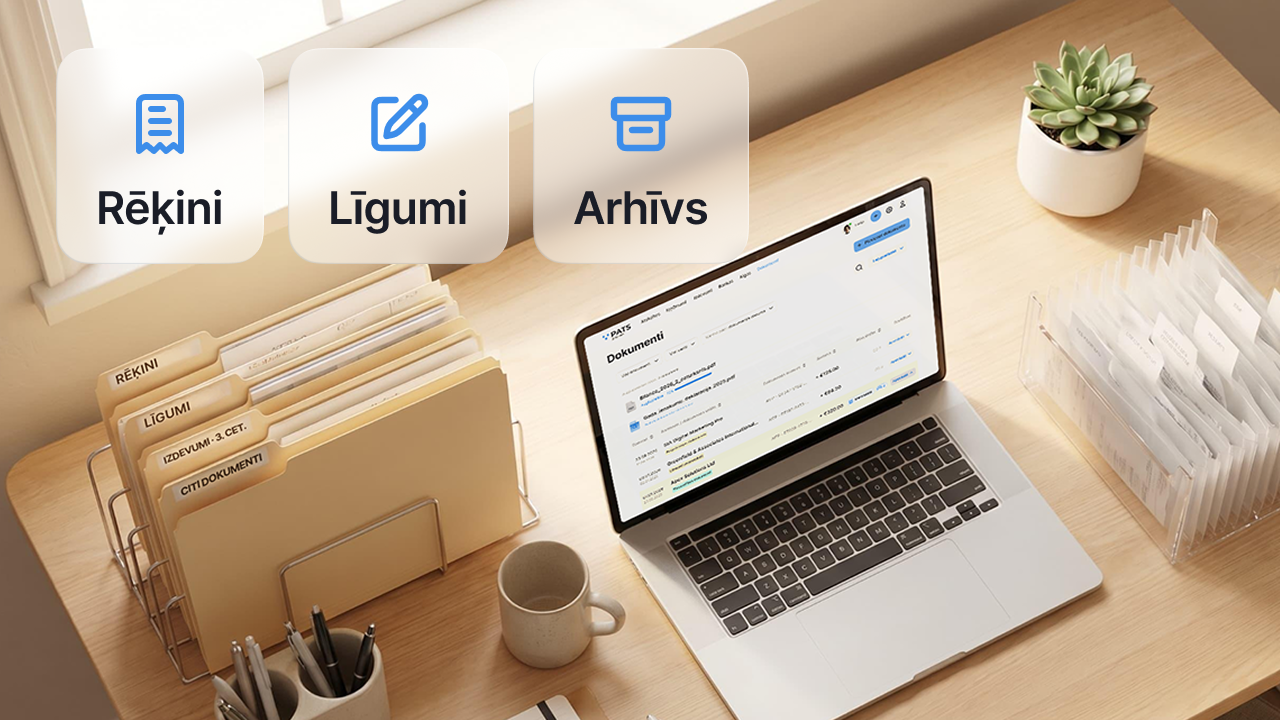
pats.lv allows accounting to be organised so that documents saved in the system are available to both the business owner or self-employed person and their accountant, according to the access rights granted.
Documents are stored in the cloud. To view an invoice or receipt saved in the system, the business owner does not have to ask the accountant to send it each time.
This also changes day-to-day cooperation.
You can check your documents yourself
If a question arises about a purchase or invoice, you can open the document saved in the system and view its contents. There is no need to wait for someone to find the right attachment in their email.
It is easier to discuss a specific transaction with your accountant
Both parties have access to the same document source. This helps clarify what was purchased, which service was received or what information is still needed.
Less time is spent asking “which invoice do you mean?”, leaving more time to resolve the issue itself.
Documents become a clearly organised part of the accounts
Invoices and receipts left only on a phone or in messages are easy to forget. Regularly uploading documents to one system helps establish a clear working routine.
It is also easier for the accountant to work when the client submits documents in a predictable way.
You stay involved in your accounting
You can entrust the work to a specialist while still understanding what is happening in the company’s accounts. Accessible documents allow you to ask specific questions, check information and make decisions with greater clarity.
pats.lv offers the advantage of a shared, transparent workspace for the client and accountant. To get the full benefit, documents need to be uploaded to the system regularly and a procedure for processing them must be agreed.
Cloud storage does not remove document retention periods or the requirements for replacing paper originals. When you stop using a system, you also need to plan in advance for transferring the documents and continuing to store them.
Check whether your documents are in order
Open a transaction from several months ago and check:
Can you find the supporting document?
Is the document fully legible?
Do you understand what the transaction was for?
Is the necessary information also available to the accountant?
Do you know where the original is kept, if it must be retained?
Is it clear how long the document must be kept?
Will you be able to access it if you change accountants?
If several questions have no clear answer, start with a single procedure for submitting and storing documents.
Try pats.lv and build an accounting process in which documents are easy to navigate and both parties understand how they work together.
Frequently asked questions
Must all accounting documents be kept for five years?
No. Five years is the minimum retention period for other supporting documents, but longer periods apply to other categories. A supporting document may also need to be kept for longer to ensure a transaction remains traceable.
Does sending a document to my accountant mean I can delete my copy?
First, make sure that the document has been received, saved in the designated place and that you will have the access you need. Sending it does not, by itself, confirm that the document retention procedure has been fulfilled.
Must documents be kept after a company closes?
Closing a company does not mean that documents are automatically destroyed. The arrangements for their continued retention must be determined in agreement with the National Archives of Latvia.
Can the business owner also view documents in pats.lv?
Yes, both the client and the accountant can access documents saved in the system according to the rights granted. This allows the client to follow their accounts and view documents without having to request each one separately.
Information checked on 23 October 2026. Any specific requirements applicable to a particular document must also be taken into account when retaining it.